Buy islb.eu ?
We are moving the project
islb.eu .
Are you interested in purchasing the domain
islb.eu ?
domain@kv-gmbh.de · 0541-91531010
Buy islb.eu ?
What is the difference between proportional and inverse proportional?
Proportional and inverse proportional relationships are two types of relationships between two variables. In a proportional relationship, as one variable increases, the other variable also increases at a constant rate. This means that the ratio between the two variables remains the same. In an inverse proportional relationship, as one variable increases, the other variable decreases at a constant rate. This means that the product of the two variables remains constant. **
How can one recognize proportional and inverse proportional relationships?
Proportional relationships can be recognized when two quantities increase or decrease at the same rate. This means that when one quantity doubles, the other quantity also doubles. Inverse proportional relationships, on the other hand, can be recognized when one quantity increases while the other decreases at a constant rate, or vice versa. This means that when one quantity doubles, the other quantity is halved. One can recognize these relationships by plotting the data on a graph and observing if the points form a straight line through the origin for proportional relationships, or if the points form a curve for inverse proportional relationships. **


Similar search terms for Non-proportional
Top-Angebote
Products related to Non-proportional:
-
All Categories Goods LED Solar Security Light Dual Motion Sensor Outdoor Floodlight With LED Technology For Energy Efficient Illumination LED Solar Security Light Dual Motion Sensor Outdoor Floodlight With LED Technology For Energy Efficient IlluminationBrighten your outdoor space with the 1 pcs of 22 LED Solar Security Light, designed for maximum visibility and security. Powered by ecofriendly solar energy, this motion sensor floodlight activates when movement is detected, offering both...63,97 $*Shipping: 0,00 $Secure redirect to the provider
-
Nonin Medical nVision Data Management Software for Oximetry Screening""" nVision SpO2 Data Management Software Nonin's innovation in pulse oximetry has led to the development of an easy oximetry reporting solution nVISION. Designed to provide effortless viewing, professional analysis, report generation and reliable..."441,00 $*Shipping: 0,00 $Secure redirect to the provider




-
What is the difference between proportional relationships and inverse proportional relationships?
Proportional relationships are those in which the two variables increase or decrease at a constant rate. In other words, when one variable doubles, the other variable also doubles. In contrast, inverse proportional relationships are those in which one variable increases as the other decreases, and vice versa. In an inverse proportional relationship, the product of the two variables remains constant. In other words, when one variable doubles, the other variable is halved. **
-
What are proportional relationships?
Proportional relationships are relationships between two quantities where they change in a consistent manner. This means that as one quantity increases or decreases, the other quantity also increases or decreases in a predictable way. In a proportional relationship, the ratio between the two quantities remains constant. This can be represented by a straight line when graphed. **
-
Which of the relationships is inversely proportional and which is directly proportional?
The relationship between the distance traveled and the time taken is inversely proportional, as the faster you travel, the less time it takes to reach a destination. On the other hand, the relationship between the force applied and the acceleration produced is directly proportional, as increasing the force applied will result in a corresponding increase in acceleration. **
-
Which of the assignments is inversely proportional and which is directly proportional?
The assignment of distance traveled and time taken is inversely proportional, as the distance traveled decreases as the time taken increases. On the other hand, the assignment of force and acceleration is directly proportional, as the force increases, the acceleration also increases. **

How can I recognize if a function is proportional or inversely proportional?
You can recognize if a function is proportional by checking if the ratio of the output to the input is constant. In other words, if the function can be written in the form y = kx, where k is a constant, then the function is proportional. On the other hand, if the function can be written in the form y = k/x, where k is a constant, then the function is inversely proportional. Additionally, if the graph of the function is a straight line passing through the origin, it is proportional, while if the graph is a hyperbola, it is inversely proportional. **
How can one determine whether it is a proportional or inverse proportional relationship?
One can determine whether a relationship is proportional or inverse proportional by examining the pattern of the data points. In a proportional relationship, as one variable increases, the other variable also increases at a constant rate. This results in a straight line passing through the origin when the data is plotted on a graph. In an inverse proportional relationship, as one variable increases, the other variable decreases at a constant rate. This relationship is represented by a curve that approaches but never touches either axis when graphed. **
Top-Angebote
Products related to Non-proportional:
-
Drop Dash Deals Dog Talking Button Communication Set Recordable Voice Buttons With Non Slip Pad & Stickers For Pet Training Dog Talking Button Communication Set Recordable Voice Buttons With Non Slip Pad & Stickers For Pet TrainingTransform your pets ability to communicate with this 29pcs Dog Talking Button Communication Set. This innovative set helps your dog or cat express their needswhether it's asking for a walk, food, or playtimeusing customizable voice commands. Each...64,97 $*Shipping: 0,00 $Secure redirect to the provider
-
All Categories Goods LED Solar Security Light Dual Motion Sensor Outdoor Floodlight With LED Technology For Energy Efficient Illumination LED Solar Security Light Dual Motion Sensor Outdoor Floodlight With LED Technology For Energy Efficient IlluminationBrighten your outdoor space with the 1 pcs of 22 LED Solar Security Light, designed for maximum visibility and security. Powered by ecofriendly solar energy, this motion sensor floodlight activates when movement is detected, offering both...63,97 $*Shipping: 0,00 $Secure redirect to the provider
-
What is the difference between proportional and inverse proportional?
Proportional and inverse proportional relationships are two types of relationships between two variables. In a proportional relationship, as one variable increases, the other variable also increases at a constant rate. This means that the ratio between the two variables remains the same. In an inverse proportional relationship, as one variable increases, the other variable decreases at a constant rate. This means that the product of the two variables remains constant. **
-
How can one recognize proportional and inverse proportional relationships?
Proportional relationships can be recognized when two quantities increase or decrease at the same rate. This means that when one quantity doubles, the other quantity also doubles. Inverse proportional relationships, on the other hand, can be recognized when one quantity increases while the other decreases at a constant rate, or vice versa. This means that when one quantity doubles, the other quantity is halved. One can recognize these relationships by plotting the data on a graph and observing if the points form a straight line through the origin for proportional relationships, or if the points form a curve for inverse proportional relationships. **
-
What is the difference between proportional relationships and inverse proportional relationships?
Proportional relationships are those in which the two variables increase or decrease at a constant rate. In other words, when one variable doubles, the other variable also doubles. In contrast, inverse proportional relationships are those in which one variable increases as the other decreases, and vice versa. In an inverse proportional relationship, the product of the two variables remains constant. In other words, when one variable doubles, the other variable is halved. **
-
What are proportional relationships?
Proportional relationships are relationships between two quantities where they change in a consistent manner. This means that as one quantity increases or decreases, the other quantity also increases or decreases in a predictable way. In a proportional relationship, the ratio between the two quantities remains constant. This can be represented by a straight line when graphed. **
Similar search terms for Non-proportional
-
Nonin Medical nVision Data Management Software for Oximetry Screening""" nVision SpO2 Data Management Software Nonin's innovation in pulse oximetry has led to the development of an easy oximetry reporting solution nVISION. Designed to provide effortless viewing, professional analysis, report generation and reliable..."441,00 $*Shipping: 0,00 $Secure redirect to the provider
-
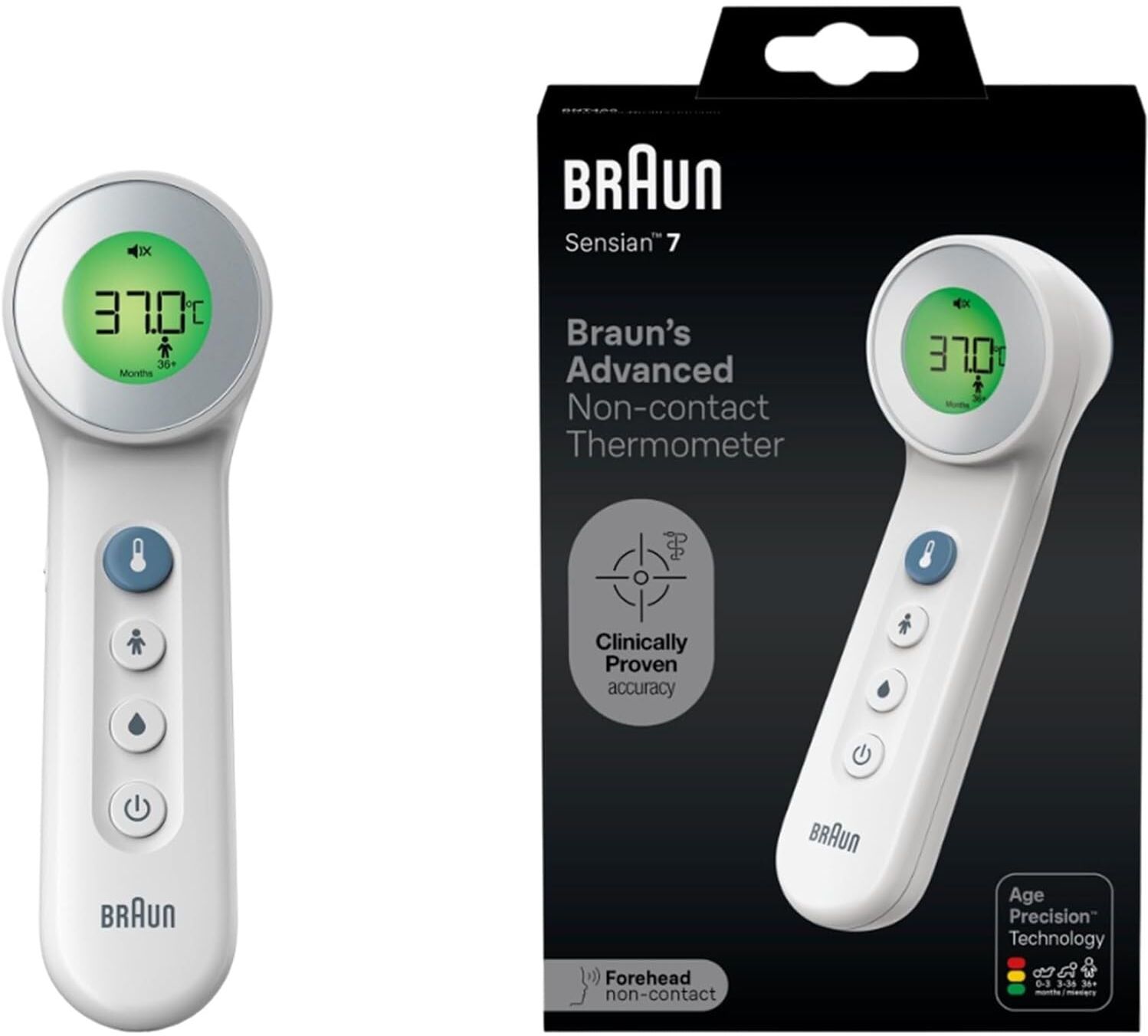
Braun Sensian 7 Forehead non-contact thermometer - Age Precision Technology - 3-in-1 Colour-Coded Digital Display - Baby and Child Friendly - BNT400B, New✅ Braun Sensian 7 Forehead Thermometer – BNT400B Model: BNT400B Type: Non-Contact Forehead Thermometer Technology: Age Precision™ Use: Baby, Child & Adult Take the stress out of temperature checks with the Braun Sensian 7 BNT400B Forehead Thermometer – the smart, gentle, and hygienic way to monitor your family’s health. ✅ No-Touch & Touch Mode Designed for maximum convenience, this thermometer offers dual measurement modes : No-touch mode : Read temperature without disturbing your child (ideal for sleeping babies). Touch mode : Simply place it gently on the forehead for a quick reading. ✅ Age Precision™ Technology Not all fevers are the same across age groups. With Braun’s unique Age Precision™ setting, you can select the age of the person (0-3 months, 3-36 months, or 36+ months), and the thermometer will interpret the reading accordingly to give a more accurate guidance. ✅ Colour-Coded Fever Guidance Quickly understand the result with a colour-coded digital display : ✅ Green – Normal temperature ⚠️ Yellow – Elevated temperature ❗ Red – High fever Perfect for giving you instant peace of mind when you need it most. ✅ 3-in-1 Functionality A truly versatile health device: Forehead temperature reading Object temperature – Check baby’s bottle, food, or bathwater Room temperature – Ensure the nursery is just right ✅ Silent Mode for Night-Time Checks Use the silent mode and backlit display to take readings in the dark without waking your child – ideal for late-night checks. ✅ Fast & Accurate Readings Delivers a precise result in just 2 seconds , powered by Braun’s trusted German-engineered sensor technology for clinical accuracy. ✅ Hygienic & Safe No probe covers needed Non-invasive and gentle – Ideal for babies and toddlers Easy to clean and use daily ✅ Ideal For: Parents with babies, toddlers, and young children Home use for all family members Safe, quick temperature checks without stress or discomfort Make health checks easier, faster, and more accurate with the Braun Sensian 7 BNT400B – your trusted partner in family wellness.37,49 £*Shipping: 0,00 £Secure redirect to the provider
-
Mac Paw CleanMyMac X - Mac Cleaning and Optimisation Software - Lifetime LicenceCleanMyMac X - Mac Cleaning and Optimisation Software Lifetime Licence Clean, Optimise and Protect Your Mac with CleanMyMac X CleanMyMac X is the best cleaning and optimisation software for Mac, designed to free up disk space, speed up macOS and protect your computer from malware and viruses. Chosen by millions of users worldwide, CleanMyMac X is the professional solution to keep your MacBook, iMac or Mac Mini in perfect condition. Why Choose CleanMyMac X? Deep Cleaning the Mac Remove junk files, system caches, obsolete logs and temporary files that take up valuable disk space. CleanMyMac X can free up tens of gigabytes with a single click, optimising the performance of your Mac. MacOS Performance Optimisation Speed up your Mac by eliminating applications that start automatically, unnecessary background processes and scripts that slow down the system. Ideal for Slow Mac or with performance problems. Antivirus and Antimalware Protection Full scan to detect and remove Mac viruses, adware, spyware and ransomware . Constantly updated database to protect your device from the latest cyber threats. Complete Uninstallation of Applications It completely removes unwanted apps along with all residual files, extensions and hidden preferences that other uninstallation methods leave on the system. Main features of CleanMyMac X ✓ Smart Scan - Automatic scanning that analyses cleanliness, protection and speed ✓ Freeing Disk Space - Finds and removes duplicate files, heavy email attachments and forgotten downloads ✓ Software Update - Keep all your applications up-to-date from a single interface ✓ System Monitoring - Menu bar widget to check CPU, RAM, battery and disk space in real time ✓ MacOS maintenance - Automatic scripts to optimise databases, repair permissions and free RAM ✓ Privacy and Security - Delete browsing history, cookies and digital traces Compatibility and Requirements Operating System macOS 10.13 High Sierra or later Compatible with : MacBook Air, MacBook Pro, iMac, Mac Mini, Mac Studio, Mac Pro Support macOS Sonoma, Ventura, Monterey, Big Sur, Catalina, Mojave Certified and Safe CleanMyMac X is Apple Certified with notarised signatures, guaranteeing maximum security and reliability. Developed by MacPaw, a leading Mac software company since 2008. Buy CleanMyMac X - Lifetime Licence Get the CleanMyMac X lifetime licence to protect and optimise your Mac. Available as a single or multi-device version. Updates included and technical support guaranteed. Keywords : Mac cleaning, macOS optimisation, Mac antivirus, free up Mac space, speed up Mac, Mac maintenance software, clean Mac disk, remove Mac malware77,81 £*Shipping: 0,00 £Secure redirect to the provider
-
Which of the relationships is inversely proportional and which is directly proportional?
The relationship between the distance traveled and the time taken is inversely proportional, as the faster you travel, the less time it takes to reach a destination. On the other hand, the relationship between the force applied and the acceleration produced is directly proportional, as increasing the force applied will result in a corresponding increase in acceleration. **
-
Which of the assignments is inversely proportional and which is directly proportional?
The assignment of distance traveled and time taken is inversely proportional, as the distance traveled decreases as the time taken increases. On the other hand, the assignment of force and acceleration is directly proportional, as the force increases, the acceleration also increases. **
-
How can I recognize if a function is proportional or inversely proportional?
You can recognize if a function is proportional by checking if the ratio of the output to the input is constant. In other words, if the function can be written in the form y = kx, where k is a constant, then the function is proportional. On the other hand, if the function can be written in the form y = k/x, where k is a constant, then the function is inversely proportional. Additionally, if the graph of the function is a straight line passing through the origin, it is proportional, while if the graph is a hyperbola, it is inversely proportional. **
-
How can one determine whether it is a proportional or inverse proportional relationship?
One can determine whether a relationship is proportional or inverse proportional by examining the pattern of the data points. In a proportional relationship, as one variable increases, the other variable also increases at a constant rate. This results in a straight line passing through the origin when the data is plotted on a graph. In an inverse proportional relationship, as one variable increases, the other variable decreases at a constant rate. This relationship is represented by a curve that approaches but never touches either axis when graphed. **
* All prices are inclusive of VAT and, if applicable, plus shipping costs. The offer information is based on the details provided by the respective shop and is updated through automated processes. Real-time updates do not occur, so deviations can occur in individual cases. ** Note: Parts of this content were created by AI.